Showing posts with label Heath. Show all posts

Thursday, July 23, 2009

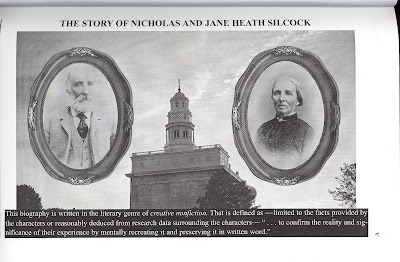
Pioneer Story of the Day: Nicholas Thomas & Jane Heath Silcock

It is time for 3rd Great Grandparents.


I have shared much about Nicholas Thomas & Jane Heath Silcock already in other posts (see the side bar and click on Silcock to read more). Here is a little summary and a few additions:


Nicholas Thomas went by Thomas. He and Jane had 16 children, one born in England, 2 in Nauvoo, 2 in St. Louis and the rest in Utah. Four of their children died before the age of 10.

Text in Italics from "Come After Us" by Melvin Banner:

When Nicholas Thomas was 10 years old his mother died. Before her death she called him to her bedside. She told him, "Thomas, the gospel of our Lord Jesus Christ is not on the earth, but will be brought back by an angel. If it comes in your day, I want you to join it." He always remembered what his mother said and when he was 13 years old he "knelt down and told the Lord that if the truth every came in my day, I would embrace it."

Nicholas relates that upon hearing Wilford Woodrfuff and Alfred Cordon declare the restoration of Christ's gospel by an angel, the spiritual stirrings in him said, "that is the truth!". Likewise, as Jane listened to the LDS interpretation of the Savior's baptism by immersion she declared, "I was immediately converted." Elder Woodruff later confirmed her a member of the Church. Nicholas and Jane never faltered in their commitment to their testimonies they received.

Nicholas Thomas came across to America alone at age 23 on the ship EMERALD with Parley P. Pratt. He earned money on the ship by remodeling the captain quarters. He worked in St. Louis to save up money and sent for his wife Jane, who was only 16 years old, and their 17 month old son Alma. She crossed on the ship the CHAMPION. They lived in Nauvoo, Illinois on the corner of Wells and Young Streets. Nicholas Thomas was a carpenter who built Parley P. Pratt's home.

He worked full time on the Nauvoo Temple and stayed until its completion. He and Jane received their endowments and were sealed in the Nauvoo Temple in January 1846. When the saints were driven from their homes, the Silcocks did not have means to travel west with the main group and instead they went to St. Louis where Nicholas Thomas searched for work and where they endured many hardships.

Jane's mother Barbara Heath and her brothers traveled west to Winter Quarters with Bishop Edward Hunter. Grandma Barbara Heath passed away not long after arriving at Winter Quarters. Jane's teenage brothers were taken in by the Hunter family.

Cholera hit St. Louis hard at this time. In the LDS community “Nicholas had been appointed to preside…he spent his time among the sick and dying. For a time it looked as if the whole city of St. Louis would be wiped out.” Jane said. “I was called to administer to the afflicted,” Nicholas recorded. Then the dreaded disease struck home for the Silcocks. On April 10, 1849, seven-month old Barbara Ann “was sick at two p.m. and at ten p.m. she was laid out a corpse.” This was another blow to sadden the Silcock family…

“There was sickness and death at every turn,” Jane told her daughter Martha. “Nicholas spent his time helping with the sick and carrying the dead to the sidewalk.” There they would be picked up by wagons to be buried in accordance with the city officials’ specifications…After July, the number afflicted began to diminish...

Nicholas recorded that “In the fall as the cholera abated I received work in a sugar refinery.” He was blessed in several ways. He was alive. His wife and Alma were alive, and he had full-time employment at good wages. “I felt I had much to be thankful for,” Jane told daughter Nina Etta, “as my husband and my son Alma were spared…though the sad blow (of Barbara’s death) was one from which I did not recover.”

After the birth of their son, Thomas, Jane had an attack of ague chills causing milk leg (phlebitis) to set in. “I was sick all winter and well into the spring of 1850,” Jane told daughter Martha. Nicholas recorded additional problems that added to Jane’s misery with milk leg. “My wife being confined caught cold and was very sick and could hardly walk.”

In 1850, Bishop Edward Hunter came to St. Louis with wonderful news. Thanks to the new Perpetual Emigrating Fund established by Brigham Young, the Silcock family could finally make the journey to the Salt Lake Valley. Nicholas Thomas, Jane, their eight year old son, Alma, and their infant son, Thomas, joined the Edward Hunter Company even though Jane could not walk. Jane would have to ride in the wagon and could not do any of the chores so they arranged with a widow to take care of the cooking and washing in exchange for transportation for the widow, her son and their belongings.

Bishop Hunter conveyed on to Jane Silcock and others with illnesses in the company, a promise from President Brigham Young that “if this people will hearken to counsel they will have good health. Women that cannot walk a mile will walk twenty by the time they get to the tops of the mountains.” Jane saw this fulfilled. Daily she gained ability to use her legs. Jane began to help the widow with the cooking until she “took turns of every other time.” She found it increasingly easy to fully care for baby Thomas. Jane told her granddaughter Eva, “by the time we arrived at the end of our journey, I recovered my health.”

They arrived in Salt Lake in October They were the first of many who were blessed by the the Perpetual Emigrating Fund. They settled eventually in Riverton area where they raised their children and welcomed more. They lived faithfully and served honorably in many callings in the church.

Martha their daughter recorded of Jane's passing at age 75, "Her last hours were quiet and full of prayer and concern for the welfare of those around her." Jane had been molded and defined in the furnace of affliction. Thus, by the close of her life those close knew they were in the presence of a pure person with a pure spirit....Mary Green, who was with Jane when she passed away reported "All was peace and quiet when the end came as she was prepared to go."

A grandson, Mahonri M. Dansie later said of his grandfather Nicholas Thomas Silcock, "I have heard him bear his testimony many times in fast and testimony meeting. He was one of the stalwarts of the day. He was true and faithful to the end. He was a honest and hard working man. I am proud to be one of his grandchildren."

Nicholas Thomas Silcock passed away at the age of 86. Both he and Jane are buried in the Riverton Cemetery.

Certainly they both walked with "Faith in Every Footstep" as many others did.

Sunday, July 19, 2009

Pioneer Story of the Day: Barbara Hulme Heath

Barbara Hulme Heath was one of my 4th Great Grandmothers.

(Her daughter was Jane Heath Silcock, who was the mother of Almira Heath Silcock Henderson, who was the mother of Nicholas Thomas Henderson, who was the father of Jay Harold Henderson)

Barbara was born in England to John Hulme and Lady Jane McDonald Hulme.

The vocation Barbara chose to follow was cooking. "Barbara worked for years in that profession, not marrying. She saved her money wisely. When she was twenty-nine years old Barbara met a very pious gentleman six years younger than herself, by the name of John Heath and fell in love. They were married in 1825...Both John and Barbara brought substantial savings accounts to the marriage, an unusual circumstance for the working class of the times. Barbara and John were well suited for each other, and were very happy in their marriage.”

Her husband John passed away in 1841. Barbara joined the Church of Jesus Christ of Latter-day Saints in England in 1845; she was about 49 years old. She and her sons decided to come to America. In October 1845 they arrived aboard the ship “Oregon” in New Orleans and then came up the Mississippi River to the boat dock in Nauvoo. Her daughter Jane met her at the dock. On the ride home Barbara found that her long journey was not yet over. "Nauvoo would be a temporary respite" as the Saints were preparing to go West.

"Barbara, being financially sound, was able to supply capital to purchase the iron and wood for her wagon. Nicholas (her son-in-law) with the help of the teenage Heath boys, provided the labor."

Before leaving she was endowed in the Nauvoo temple on January 8, 1846.

"Barbara Heath and her sons were assigned to Bishop Hunter's company." They had planned to leave February 16th with the main group of Saints. However, Bishop Hunter was counseled to wait and see if he could sell more of his property first.

"In April, discouraged over bleak sales of his property, Edward Hunter's family and Barbara's family prepared their wagons to move across the Mississippi. By now the grass was growing and the trail west was well traveled."

"Barbara’s sons...had not yet joined the Church. Bishop Hunter had a valuable influence on them through their close association during the months of preparation. The Bishop and his wife, Ann only had one daughter...and no sons. Barbara was grateful for the Bishop's mature and fatherly example. As they were saying goodbye, Barbara's last words to Jane were, "If it was not for the salvation of my boys, I would not leave you."

"By the end of August the Hunters and Heaths had reached Council Bluffs on the Missouri River. It was now the 'sickly season.' Bishop Hunter and his family were so sick they could not continue. Bishop Hunter recorded, 'I suffered with sickness, also seven at a time.' Ann Hunter told Jane later in Salt Lake City of this trying time. She explained the Barbara was the Hunter family's life saver. Barbara (who had been sick earlier in their travels) had regained strength but was still sick. Sister Hunter explained that Barbara cooked the meals and nursed those too ill to leave their beds. Ague symptoms include serious thirst. Sister Hunter said there were times when Barbara was too ill to walk but she crawled from bed to bed of those more ill and gave them water. Finally with that devoted care, they regained health enough at the end of September to cross the Missouri River to Winter Quarters."

"Barbara developed other complications in addition to the ague...Sister Hunter told Jane later in Salt Lake City that Barbara became ill with black canker and lay ill for fourteen weeks. Before Barbara died, she told a dear Sister, Elizabeth Melroy, "Write to my daughter in St. Louis and tell her that I am no more, but I have died in hopes of a bright and glorious resurrection." She passed away at Winter Quarters, October 20, 1846 at age 50.

Text in "quotes" is taken from the book "Come After Us" by Melvin Banner (a biography of Nicholas Thomas Silcock and Jane Heath Silcock)

Text not in quotes and italic additions within the quoted text were added by Marie Arnold.